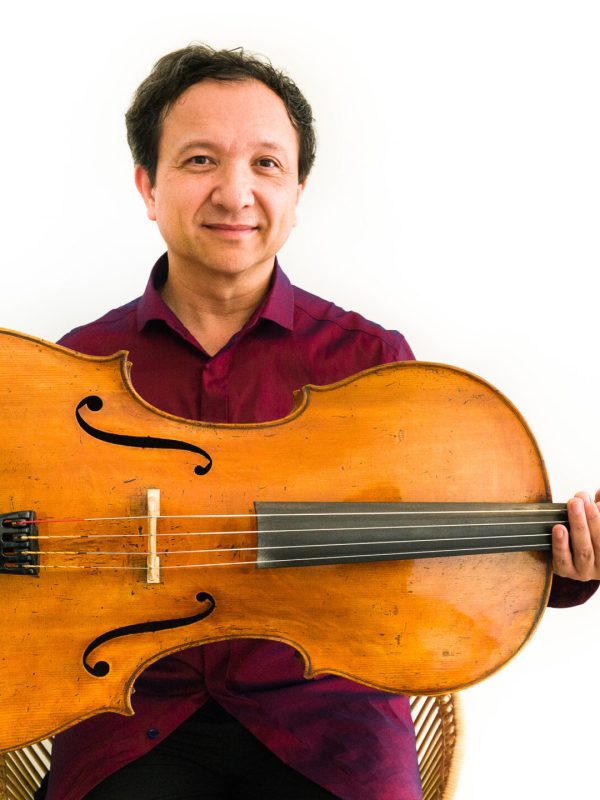
Born into a family of musicians in Beijing, China, “Benny” Yi-Bing Chu began studying the cello at the age of eight under the guidance of his father, a distinguished cello professor at the Central Conservatory of Music. His early musical training was deeply rooted in discipline and artistry, influenced by both of his parents, who were faculty members at the Central Conservatory. His mother, of Swiss-Chinese descent, and his father, a respected cellist, laid a strong foundation for his future.
Despite the challenges of the Cultural Revolution, when classical music was banned in China, Chu began performing publicly at an early age and recorded his first album at just 10 years old. In 1983, he moved to France to study at the Conservatoire National Supérieur de Musique de Paris under the legendary cellist Maurice Gendron. He graduated with the prestigious Premier Prix in 1987, becoming only the third Chinese musician to earn this honor, following Ma Sicong and Xian Xinghai.
In 1986, Chu gained international acclaim by winning First Prize at the Geneva International Music Competition, making him the first Chinese cellist to do so. This milestone launched his European performance career. In 1989, he was appointed principal cellist of the Sinfonieorchester Basel in Switzerland, a position he held for 15 years. He also appeared as guest principal cellist with the Bavarian Radio Symphony Orchestra and performed with renowned cellists such as Mstislav Rostropovich and Bernard Greenhouse.
Chu expanded his musical pursuits by studying conducting at the Basel Music Academy, leading to engagements with major orchestras including the Hallé Orchestra, Munich Symphony Orchestra, Düsseldorf Symphony Orchestra, and Berlin Symphony Orchestra.
In 2004, after 21 years in Europe, Chu returned to China to serve as Professor of Cello at the Central Conservatory of Music. There, he became a pivotal figure in advancing cello performance and chamber music education nationwide. He founded the China Philharmonic Cellists, an ensemble composed of his students, with whom he has toured extensively, performing hundreds of concerts across China — including at universities, hospitals, factories, and correctional facilities — reaching audiences often unfamiliar with classical music.